 English
 русский
 Español
 عربى
عربى

A forklift tire press is not a piece of equipment you can improvise with a pry bar and a heavy hammer. If you have ever watched a brand-new press-on tire slide off its rim after only a few shifts of warehouse operation, you already know what a poor press fit costs: downtime, lost throughput, and a safety incident waiting to happen. The metal base band of a press-on tire is manufactured with a bore that is deliberately smaller than the rim it mounts onto. In a well-designed assembly, that interference fit is what keeps the tire locked to the wheel during acceleration, braking, and steering.
This guide covers the forklift tire press from the ground up: why the machine is indispensable, how to choose the right press, what the complete installation sequence looks like, what fitment standards you need to verify before pressing, and how to avoid the common mistakes that turn a routine tire change into an expensive repair.
The short answer upfront: press-on solid forklift tires cannot be installed safely without a press. The rest of this article explains the mechanical reasons behind that conclusion and provides the practical knowledge you need to make the pressing process reliable and repeatable.
Why Forklift Tire Pressing Is a Non-Negotiable Skill
The design principle behind a press-on tire is a controlled interference fit. The bore of the steel base band is machined to be a specified fraction smaller than the outside diameter of the rim. Typical interference values for industrial solid tires fall in the range of 0.03 to 0.08 percent of the rim diameter, although the exact figure is set by the manufacturer for a given tire size.
This small dimensional difference creates several critical effects:
- The radial clamping force produced by the interference prevents circumferential slippage when the forklift transmits drive torque to the wheel.
- The interference creates a water-resistant seal at the bore-to-rim interface, reducing the risk of internal corrosion.
- The keyway in the tire base engages with a key on the rim, mechanically locking the assembly against rotation.
Without the axial force from a press, you cannot push the tire over the rim in a controlled manner. A hammer blow might physically move the tire a few millimeters, but the force is completely uneven. The result is a bent base band, a damaged rim flange, or a tire that seats incorrectly. Even if you manage to slide the tire most of the way onto the rim, any deformation of the base band will produce a gap between the tire and the rim. That gap allows the tire to slip under load.
Equally important is the safety consequence. A forklift that loses traction during a tight corner or a braking maneuver can cause serious damage. In a busy warehouse with pedestrians and racking, the cost of a tire that lets go is measured in more than repair bills.
Understanding the Different Forklift Tire Types
Forklift tires are not interchangeable. The type of tire on your lift truck determines the installation method, the required equipment, and the selection criteria for replacement. The three main categories are press-on solid tires, solid pneumatic tires, and pneumatic tires.
Press-On Solid Tires
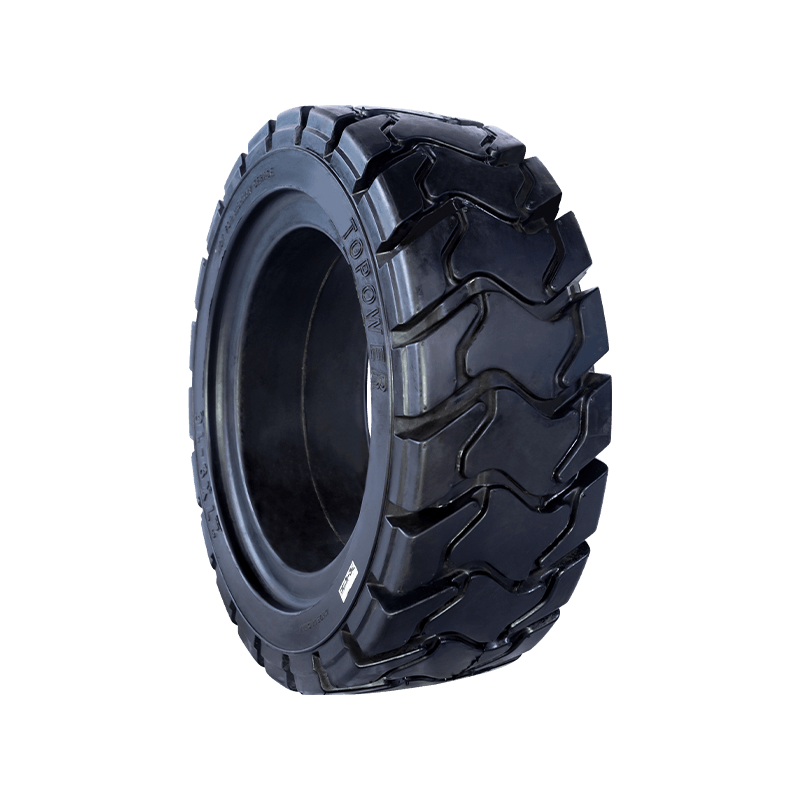
Press-on solid tires are constructed as a solid rubber tread bonded to a thin steel base band. The base band has a precision-machined bore and a keyway. The tire is installed over a wheel rim with a slightly smaller diameter. The mounting process uses a hydraulic or pneumatic press, which provides the axial force required to overcome the interference fit. Press-on tires deliver excellent load capacity and are immune to punctures, making them the default choice for forklifts operating in yards, ports, foundries, and manufacturing plants.
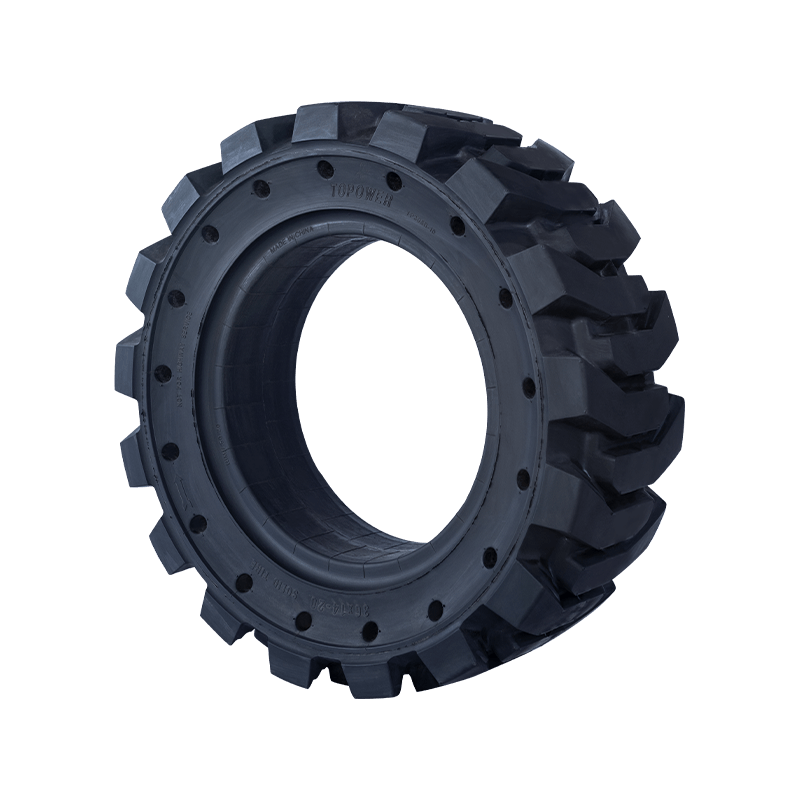
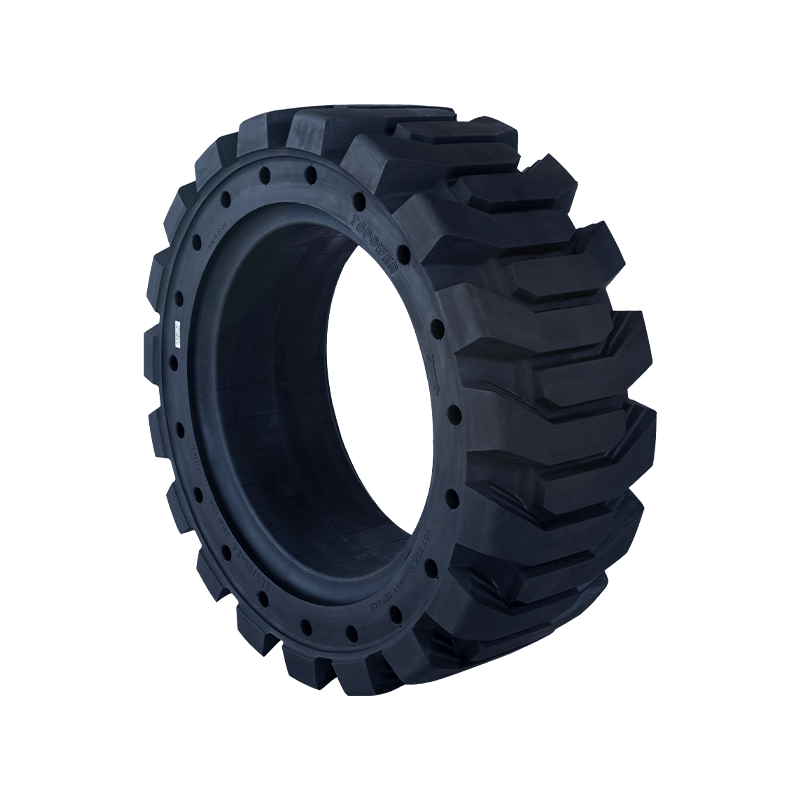
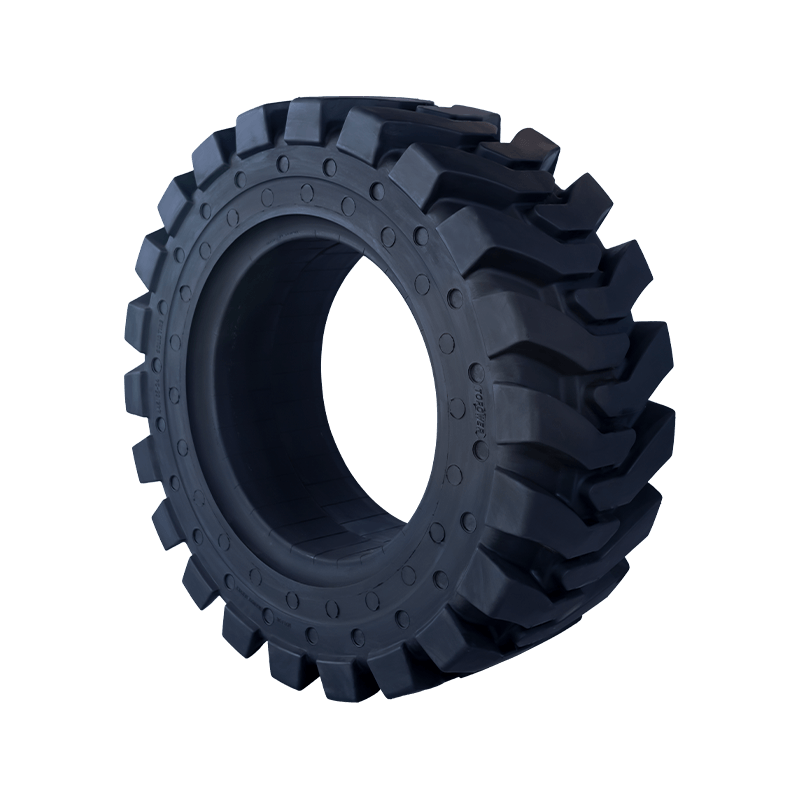
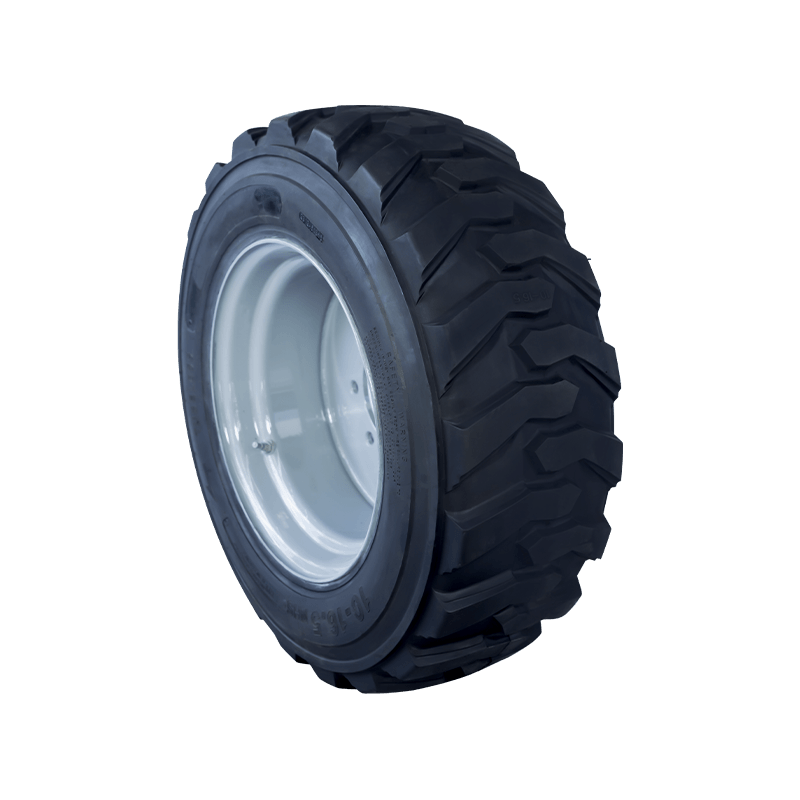
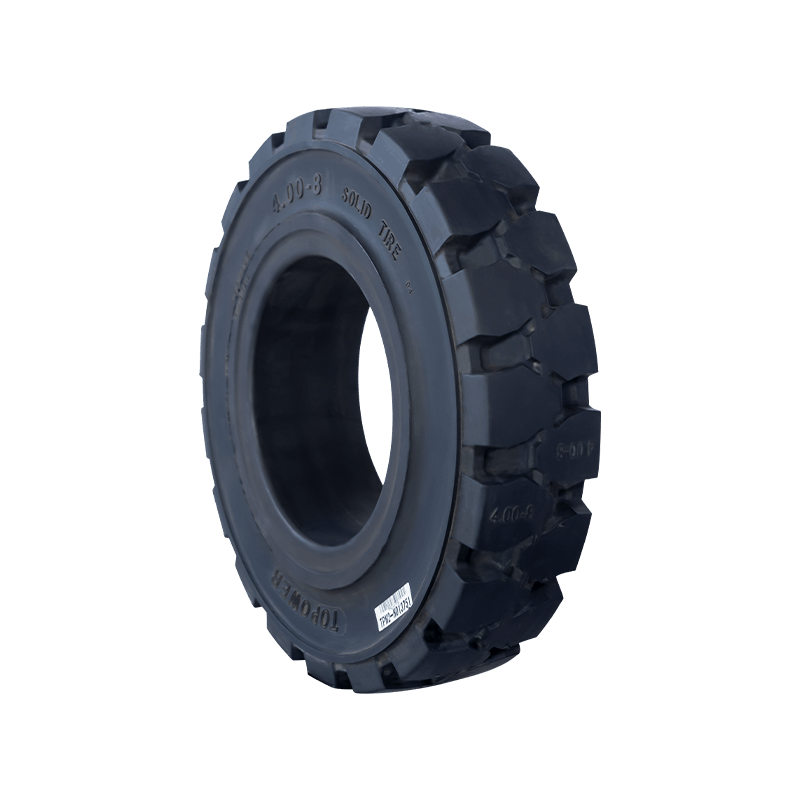 Solid Pneumatic Rim Forklift Tire for Harsh Working ConditionsThis solid tire is designed to mount on pneumatic rims, offering shock absorption and puncture resistance. It suits demanding environments like foundries and ports, with options for non-marking compounds.View Product →
Solid Pneumatic Tires
Solid pneumatic tires, also called resilient tires, have a solid rubber body with a profile that resembles a conventional pneumatic tire. They are designed to mount on pneumatic rims and offer better shock absorption than press-on tires. Installation does not always require a dedicated fork lift tire press, depending on the rim and tire dimensions. However, some wider profiles need a press or a specialized tire changer to seat the tire correctly.
Pneumatic Tires
Pneumatic tires are still used on many forklifts, particularly in applications where ride comfort is a priority and the ground is uneven. They require tire-changing equipment, bead lubrication, and an inflation cage. A forklift tire press is not used for standard pneumatic installation.
Which Tires Actually Require a Press?
The answer is straightforward: press-on solid tires absolutely require a press. Solid pneumatic tires may require a press for certain profiles, and pneumatic tires never require a press. When you schedule maintenance, confirm the tire type before selecting the tooling.
The following table summarizes the differences and the installation requirements.
| Tire Type | Construction | Press Needed? | Typical Application |
|---|---|---|---|
| Press-On Solid | Solid rubber on steel base band | Yes, hydraulic or pneumatic press | Warehouses, ports, foundries, high-load work |
| Solid Pneumatic | Solid rubber with pneumatic shape | Sometimes, depending on width | Rough terrain, shock isolation, general use |
| Pneumatic | Air-filled | No, tire changer and inflation cage | Uneven ground, comfort-focused operations |
This distinction prevents a common mistake: attempting to press a solid pneumatic tire with the same force intended for a press-on tire. The solid pneumatic tire does not have a rigid base band, and the applied pressure can damage the bead area.
Forklift Tire Press Equipment Explained
Once you know you are working with press-on tires, the next step is selecting the right press. A forklift tire press must deliver sufficient force, have the correct platen dimensions, and offer the control needed to seat the tire evenly.
Hydraulic Tire Presses
Hydraulic presses are the workhorses of industrial tire maintenance. They use a hydraulic cylinder to drive a ram downward, and the force is measured in tons. A typical C-frame hydraulic press for forklift tires has a working capacity of 20 to 80 tons. The pressure is adjustable, which allows the technician to apply a slow, steady force during the initial seating phase and then increase the pressure as needed.
The main advantage of a hydraulic press is the combination of high force and precise control. Hydraulic systems are also forgiving: they can hold pressure, which is useful when a tire needs to stay on the rim for a few minutes to permit the rubber to decompress after the press.
On the downside, hydraulic presses require maintenance of the hydraulic fluid, seals, and pump. In a dirty industrial environment, a hydraulic press can be vulnerable if it is not kept clean.
Pneumatic Tire Presses
Pneumatic presses use compressed air to drive a piston or a motor. They are simpler in design, have no hydraulic oil, and generally cost less. The force is limited by the available air pressure and the piston size. For small to medium-sized forklift press-on tires, a pneumatic press with a capacity of 25 to 40 tons can be sufficient.
Pneumatic presses are a popular choice for workshops that already have a compressed air system and need a relatively inexpensive way to handle tire changes without waiting for a hydraulic unit.
Manual and Bench-Mounted Presses
For light-duty work such as pallet jack tires or small caster wheels, a manual press with a hand-operated hydraulic pump can be adequate. These units are not recommended for full-size forklift tires because they do not generate enough force and the operation is slow. They are useful as a secondary tool for small press-on applications that share the same basic principle.
What to Look for in a Tire Press
When evaluating a press, the following specifications matter:
- Tonnage capacity: As a rule of thumb, a 30-ton hydraulic press is the minimum for a 12-inch rim press-on tire. For a 15-inch rim, a 50-ton or 80-ton press offers a comfortable safety margin.
- Platen size: The opening between the columns must accommodate the full tire diameter. For a 27-inch outside diameter tire, look for a platen width of at least 30 inches.
- Stroke length: A stroke of 6 to 10 inches is typical for forklift tire presses. A longer stroke is useful for larger tires or for removing them with an adapter.
- Speed control: The ability to switch between a fast approach and a slow pressing speed is essential. The slow speed prevents the tire from being suddenly crushed at the moment it engages the rim, which reduces the risk of damage.
- Safety features: Guards, a two-hand operation, and an emergency stop are non-optional. The crushing zone of a press is one of the most dangerous areas in the maintenance shop.
In addition to the press itself, you need appropriate adapter plates or pressing rings. These fixtures transfer the force from the ram to the metal base band of the tire, ensuring that the rubber sidewall is not compressed or damaged. A set of adapters for different rim diameters allows you to handle a wider range of tires with the same press.
Step-by-Step: How to Press a Forklift Tire
The process looks straightforward, but the attention to detail in each step determines whether the tire lasts a full service life or fails early. This procedure is specific to press-on solid forklift tires mounted on a rigid rim.
Preparing the Forklift and Wheel Assembly
Before any work begins, the forklift must be raised and supported. Use a hydraulic jack to lift the machine, then place solid blocks under the axle or frame at four points. Never rely on the hydraulic jack alone. Once the lift truck is stable, remove the wheel with the appropriate lug wrench or impact tool. If the wheel feels stuck, do not force it with a hammer; use a pry bar gently or a wheel puller if necessary.
Place the removed wheel assembly on a flat, clean surface. If the wheel is still mounted on the forklift, it is tempting to try to press the tire on the ground. This is never a good idea. The wheel must be free to be positioned correctly on the press bed, and the pressing force must be perfectly vertical.
Removing a Press-On Tire from the Rim
To remove an old tire, mount the wheel assembly on the tire press table with the base band facing the adapter. Use an adapter disc that contacts the rigid metal band, not the rubber. As you apply pressure, the tire should slide off evenly. If it does not move, stop. Check for a binding key, a deformed rim, or strong corrosion. Free the stuck part with penetrating oil and allow time for the oil to work.
Do not attempt to use a cutting torch on a stuck press-on tire unless you have the proper experience and the tire is designed to be cut. Cutting a press-on tire without the correct tools can create hot fragments and toxic fumes.
Inspecting and Cleaning the Rim
Clean the rim bore and the keyway with a wire brush, compressed air, and a clean cloth. Remove all corrosion, old rubber residue, and debris. Inspect the rim flange for cracks, bending, or mushrooming. A rim that has been exposed to high loading and repeated tire changes can develop fatigue cracks. If you find a crack, replace the rim before fitting a new tire.
Check the key and keyway for wear. A worn key may not provide enough anti-rotation support, and an enlarged keyway will allow the tire to rotate on the rim under torque. These parts should be replaced when worn, not repaired.
Fitting the New Tire onto the Rim
Before you press, confirm that the new tire and rim are a matched set. Then follow this sequence:
- Place the new tire on the press bed, with the base band facing upward.
- Align the keyway in the tire with the key on the rim.
- Apply a thin layer of tire lubricant to the rim bore and the tire base bore. Use a water-based rubber lubricant, not a mineral oil, which can soften the rubber over time.
- Position the rim over the tire, ensuring that the key is at the same angle and will engage as the rim moves down.
- Use an adapter plate that fits the outside diameter of the rim or the base band of the tire. The force must be applied to the rigid metal, not to the rubber tread.
- Start the press at low speed. Watch the gap between the tire base and the rim as the rim descends. The engagement should be even around the circumference.
- If one side of the tire starts to slide before the other, stop and re-check the alignment. The misalignment may be caused by an uneven keyway or a burr on the rim.
- Continue pressing at a controlled speed until the tire is fully seated. You will feel resistance increase as the tire stops moving forward, which indicates that the base is fully seated against the rim flange.
- Release the pressure, remove the assembly, and clean the lubricant residue.
After the Press: Post-Installation Checks
The job is not finished when the tire stops moving. Perform these checks before re-installing the wheel on the forklift:
- Measure the tire width and overall diameter and compare to the manufacturer's specifications.
- Look for a uniform gap or a full flush contact between the tire base and the rim flange.
- Rotate the wheel assembly and look for wobble or visible eccentricity.
- When the wheel is installed, tighten the lug nuts in a star pattern to the torque specified by the forklift manufacturer.
Safety Protocols for Tire Pressing
A forklift tire press is a piece of heavy equipment, and the forces involved are enough to crush fingers, trap clothing, or release a tire with sudden energy. Safety must be a fixed part of standard operating procedure, not an optional afterthought.
Machine Safety
- Ensure that the press has a functioning emergency stop button, and that it is tested at the start of each shift.
- Require two-hand operation guards. The operator's hands must be on both controls, away from the danger zone.
- Keep the press bed clean. Loose tools, bolts, or wrenches can become projectiles if they are caught by the moving ram.
- Do not operate a press with visible leaks in the hydraulic circuit. A hydraulic failure can cause the ram to move unexpectedly.
- Never leave the press in a loaded position while you walk away. If the cycle must be paused, remove the load and lower the ram completely.
Personal Protective Equipment
The following table lists the essential PPE for tire pressing work. Local regulations may require additional equipment.
| PPE Item | Purpose | Recommended Specification |
|---|---|---|
| Safety glasses | Protect against rust, debris, and aerosol particles during cleaning | Impact-rated with side shields |
| Cut-resistant gloves | Protect hands while handling rim edges and steel base bands | ANSI A4 or higher |
| Steel-toe boots | Protect feet from dropped wheels and heavy tires | Certified with puncture-resistant soles |
| Hearing protection | Protect against press noise and impact | NRR 25 or higher |
| Nitrile gloves | Protect skin when applying tire lubricant | Chemical-resistant |
Tire Handling and Storage
Large press-on tires can weigh between 30 and 80 kilograms, and a 27-inch tire is difficult to handle by hand. Use a tire dolly, a hoist, or a wheel trolley to lift and position tires. Store tires vertically, not flat, and keep them away from heat sources, direct sunlight, and ozone-generating equipment such as electric motors and generators. Ozone is one of the most aggressive enemies of rubber and will reduce the tire's service life even when it is not in use.
When you store press-on tires, keep the bore clean and protected. Be careful not to damage the keyway edge, since a burr in the keyway can prevent a clean alignment during the pressing operation.
Press-On Tire Fitment and Interchange Standards
Fitment data is the difference between a tire that fits properly and one that becomes a liability. When you order a replacement press-on tire, you cannot rely on the outside diameter or tread width alone. The bore of the steel base band, the keyway dimensions, and the rim diameter are all critical.
Matching Tire to Rim Diameter
The interference fit between the tire bore and the rim is not optional. It is the mechanism that prevents the tire from slipping when torque is applied. The interference is designed into the tire by the manufacturer and typically falls in a narrow range. A tire with the correct bore will meet the rim with a measurable resistance during pressing. A tire with a bore that is too large will not hold; one with a bore that is too small may crack the rim or become impossible to install.
The rule is simple: verify the rim diameter and the tire bore specification before you order. If you are replacing a tire on an existing rim, measure the rim diameter with a caliper at several points and confirm it matches the manufacturer's recommended interference envelope.
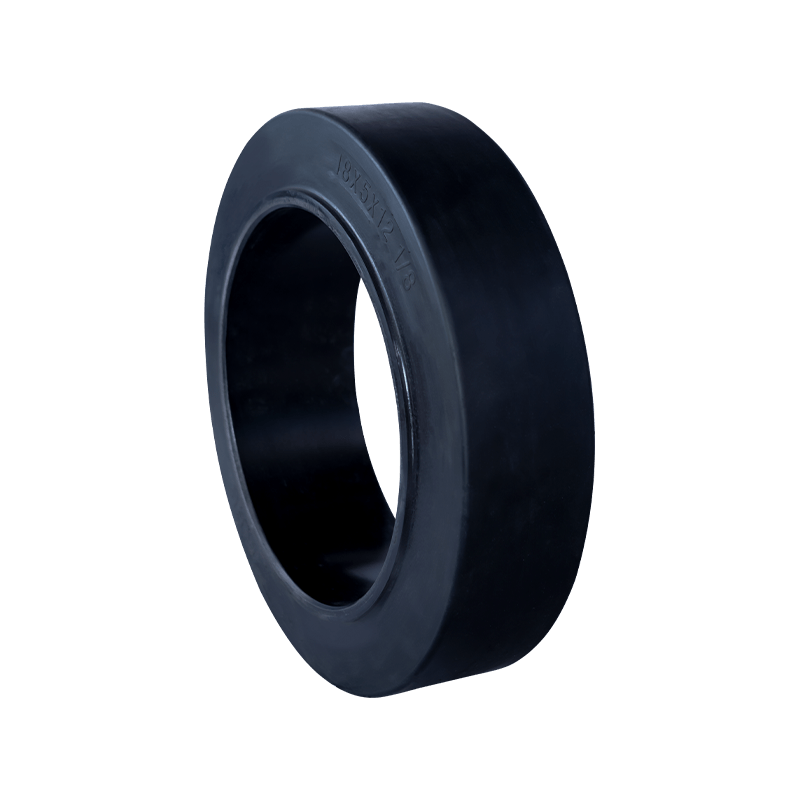 Reusable Steel Base Band Press-On Solid TireA press-on solid tire with a bonded tread and reusable steel rim, reducing long-term costs. Ideal for operations requiring strong steering and high wear resistance, compatible with various rim sizes.View Product →
Structural Width and Rim Width
The tire width designation is part of the standard press-on size nomenclature. For a size like 21 x 7 x 12, the 21 is the outside diameter in inches, the 7 is the tread width in inches, and the 12 is the rim diameter in inches. The rim width should match the tire width, not just the rim diameter. If you mount a tire with a width of 7 inches on a rim meant for a 6-inch wide tire, the bead area will not seat properly and the tire may shift laterally during operation.
Load Capacity, Speed, and Duty Cycle
A press-on tire carries a load rating that is only valid at a defined speed. As speed increases, the maximum allowable load decreases. Most forklift tire manufacturers publish load capacity charts that show the reduction as a function of operating speed and duty cycle. A tire rated for 5,000 kilograms at 10 km/h may not be rated for more than 3,000 kilograms at 25 km/h. Ignoring this relationship leads to heat build-up and premature tire failure.
Understanding the loadbearing capacity of industrial solid tires is not just a technical exercise. It is a direct factor in the total cost of ownership of a forklift fleet. A tire that is slightly too small for the duty cycle will stop performing within months, while a properly specified tire will run for years.
Bore Size and Keyway Dimensions
The keyway on the tire base band is a rectangular or semicircular slot. It must match the key size exactly. When pressing the tire onto the rim, the key should be aligned before the press cycle begins. A mismatched keyway will cause the tire to bind during the press. Do not try to force it. Stop the press, remove the assembly, and confirm the keyway dimensions with the manufacturer's documentation.
Beyond the Press: When Does a Tire Need Replacement?
Installing a tire correctly is only part of the lifecycle. The replacement schedule of press-on tires depends on abuse, environment, and maintenance practices. Here is what to look for when evaluating a tire that has been in service.
Tread Wear Indicators
Most industrial solid tires have a molded wear indicator near the base of the tread groove. When the tread has worn down to this indicator, the tire no longer provides adequate traction and must be replaced. Tread depth measurement with a gauge is the most reliable method. A tire worn to the indicator also has less rubber between the tread and the base band, which reduces the tire's ability to absorb impacts and heat.
Chunking and Sidewall Damage
Chunking means that small pieces of rubber have broken away from the tread or the sidewall. It is caused by sharp metal shavings, glass, or other debris, and by excessive heat that softens the rubber. Chunking is more than a cosmetic annoyance: the damaged surface forms a stress concentration point that can grow rapidly. In an environment with metal scrap, choose a compound that is specifically designed for cut and chip resistance.
Debonding Between Tire and Rim
Debonding is the failure of the bond between the rubber compound and the steel base band. Early symptoms include a slight give at the base of the tire or a gap that appears at the edge of the band. Debonded tires cannot be repaired and must be scrapped. A forklift with a debonded tire may suddenly lose traction because the tire can slip independently of the wheel.
Regular Inspection Routine
A quick visual check at the start of each shift and a more thorough inspection every week should be part of the maintenance routine. The regular inspection aspects of industrial solid tires include tread depth, sidewall condition, tire-to-rim seating, keyway engagement, and heat build-up.
Do not wait for a tire to fail in the middle of the shift. Replacing a worn tire in a planned maintenance window takes an hour. Replacing a failed tire during peak operating time can stop production and force the forklift out of service for several hours.
Pressing Forklift Tires in Practice: Common Scenarios
The same pressing procedure is applied in very different working environments. Understanding how the environment affects tire choice and press maintenance helps you plan better and avoid surprises.
Warehouse and Distribution Centers
Warehouse operations are usually indoors on clean concrete. The load is moved at moderate speeds, and the most common requirement is that the tire leaves no black marks on the floor.
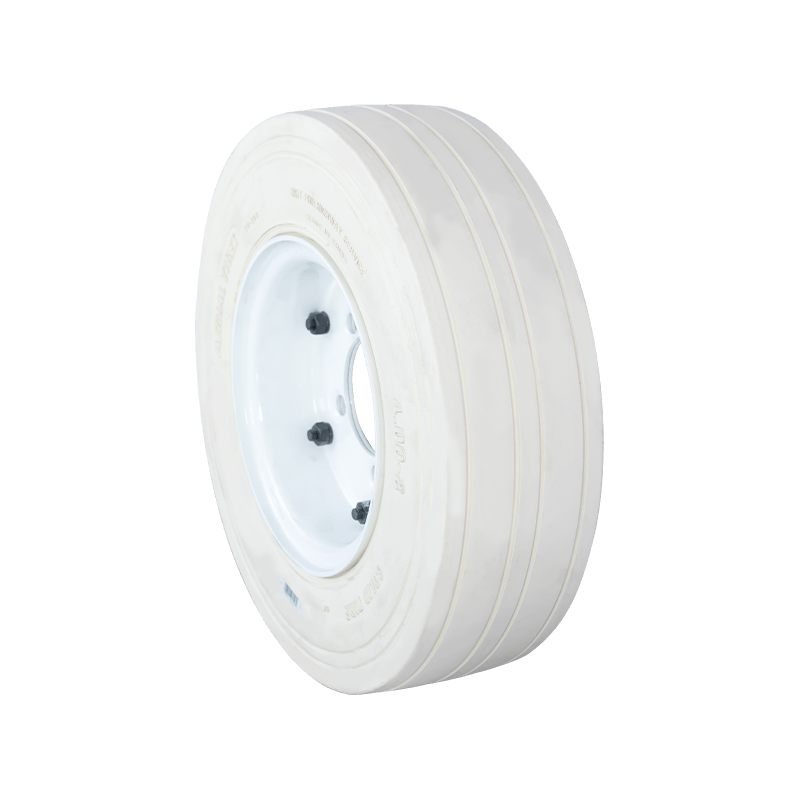 Non-Marking Solid Tire for Clean Indoor EnvironmentsThis non-marking tire uses a light-colored compound to avoid floor stains, meeting hygiene standards in warehouses and food centers. Available in press-fit or bonded designs, it ensures clean operation.View Product →
This is where non-marking solid tires become important. The rubber compound used in these tires produces little or no visible residue, keeping the floor clean and meeting hygiene requirements in food distribution centers and similar facilities. In this environment, a 30-ton hydraulic press is usually enough for a standard 12-inch rim press-on tire. Press maintenance mainly involves keeping the hydraulic fluid clean and checking the safety guards.
Ports and Intermodal Terminals
Ports and container terminals operate heavy lift trucks that carry massive loads. The tires used on this equipment are much larger, which means the pressing force must be higher as well. A 50-ton or 80-ton hydraulic press is the standard in this segment. The press must be equipped with a heavy-duty base and a wide platen to accommodate the larger tire diameter.
Corrosion is a serious issue in marine environments. Saltwater, humidity, and salt spray attack the rim and the tire base band. Before pressing a new tire onto a rim from a port forklift, spend extra time cleaning the rim bore and inspecting for pitting. Pitting in the interference area can reduce the effective contact area and cause localized slipping.
Manufacturing and Heavy Industry
Manufacturing facilities often have metal filings, broken glass, and sharp scrap on the floor. Solid tires are chosen for their cut resistance. The pressing process is the same, but tire compound selection becomes the dominant factor. A tire that is not cut-resistant will fail prematurely, and the downtime cost will be far higher than the initial purchase price.
In heavy industry, the press is also exposed to a harsh environment. Dust and metal chips can enter the hydraulic cylinder seals. A regular cleaning schedule for the press and the adapter plates is necessary to keep the equipment working.
Common Mistakes When Using a Forklift Tire Press
Even experienced workshops make avoidable errors. The following mistakes are the most common causes of tire failure after a pressing operation.
Using the Wrong Type of Lubricant
A petroleum-based grease may seem convenient, but it can attack the rubber compound and cause cracking. Tire manufacturers specify a water-based lubricant for mounting procedures. Over-lubricating is also a problem: excessive lubricant reduces the friction between the tire and rim, which means the interference fit alone has to do more work.
Applying Force to the Rubber Sidewall
One of the most common errors is positioning the adapter plate so that it contacts the rubber tread or sidewall instead of the steel base band. The rubber is not designed for high axial compression. Pushing on it can deform the sidewall, weaken the bond between the rubber and the base band, and permanently damage the tire even though it appears to seat correctly.
Skipping Rim Inspection
It is tempting to just press the new tire onto the old rim. But if the rim has a bent flange, a worn key, or a corroded bore, the new tire cannot perform as designed. The rim is part of the wheel assembly and should receive the same level of scrutiny as the tire.
Ignoring the Manufacturer's Load Chart
The load chart is not a suggestion. It defines the maximum load for a given operating speed and application. Overloading a tire reduces its service life and increases the risk of debonding. In the context of pressing, it also means that a tire chosen for the wrong load category will start to fail soon after installation, regardless of how well the press work was done.
Using the Press as a Workbench
A tire press is a precision tool, not a multipurpose bench. Using it as a support for heavy equipment, or letting it sit under a constant load when it is not in use, can bend the frame and reduce the accuracy of the pressing stroke. Keep the press dedicated to tire pressing and protect it with a cover when not in use.
Choosing the Right Forklift Solid Tire
Selecting the correct press-on solid tire is an investment decision. The product you choose must meet load requirements, operating conditions, and environmental constraints. Here are the main selection criteria.
Compound Selection
The rubber compound governs the tire's behavior in three important areas: heat resistance, cut resistance, and marking. A compound that is optimized for one of these characteristics compromises the others. In a facility where the floor is clean and forklifts travel at moderate speeds, heat generation is not the primary concern, and a non-marking compound becomes appropriate. In a scrap yard, a cut-resistant compound is the only sensible choice.
Load Capacity and Speed
The load capacity of a press-on tire decreases as the operating speed increases. This is a physical limit created by heat generation. Ask the tire manufacturer for the load capacity at your actual travel speed. If they send you a chart that only lists one number, request the speed-related data as well.
Press-On vs. Solid Pneumatic
Press-on solid tires are the most rigid option, which makes them ideal for high stability and heavy loads. If your forklift frequently operates on uneven outdoor surfaces, the shock absorbing ability of a solid pneumatic tire may be preferable. These two options require different installation procedures, so the decision affects the equipment in your workshop.
Supplier Technical Support
A reliable tire supplier should be able to provide accurate technical documentation: dimensions, bore tolerances, keyway specifications, load charts, and a clear explanation of the correct pressing procedure. If a supplier gives vague data or no data at all, it is a red flag. The technical data are your only tool for making sure the press-on tire will work on your rim and under your operating conditions.
Conclusion
A forklift tire press is the only safe and correct way to install a press-on solid tire. The machine enables the controlled, uniform force required to overcome the interference fit and seat the tire on the rim without damaging the tire base or the rim.
The results of a proper pressing process are measurable: longer tire life, fewer unplanned failures, and a safer operating environment. If you are responsible for fleet maintenance, invest in a press with sufficient tonnage, the right platen size, and proper safety controls. Then make sure your team follows the fitment and inspection protocols outlined in this article.
When a press-on tire is installed correctly, it can deliver thousands of hours of service. The press is not just a tool; it is a direct contributor to the productivity of your material handling operation.