 English
 русский
 Español
 عربى
عربى
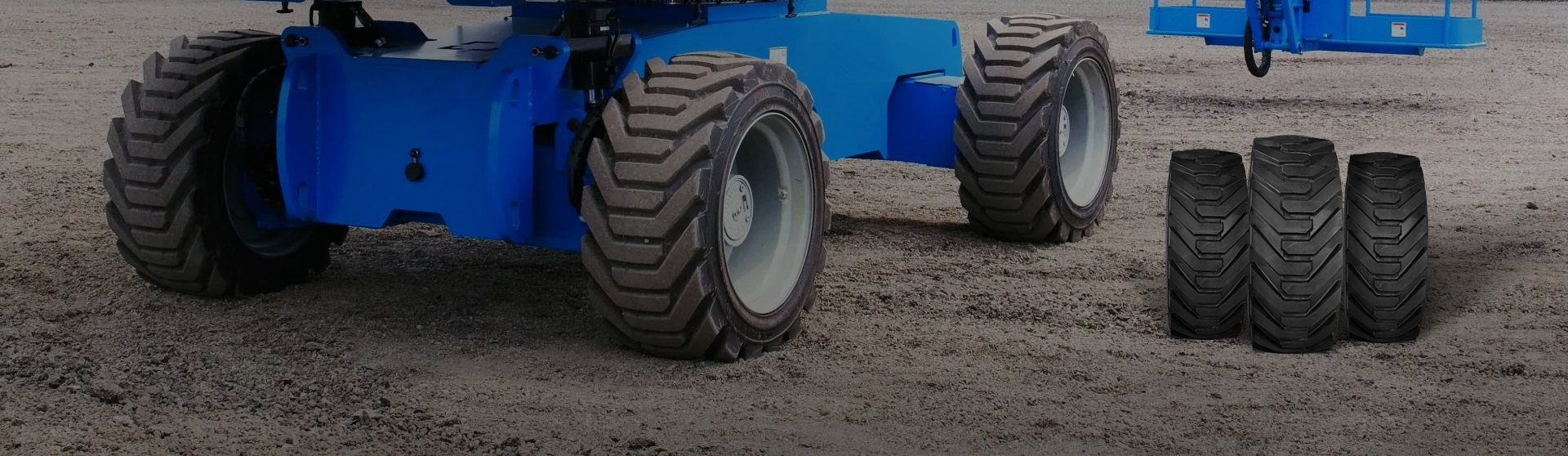

What Makes a Forklift Solid Tyre Different from Other Tyre Types
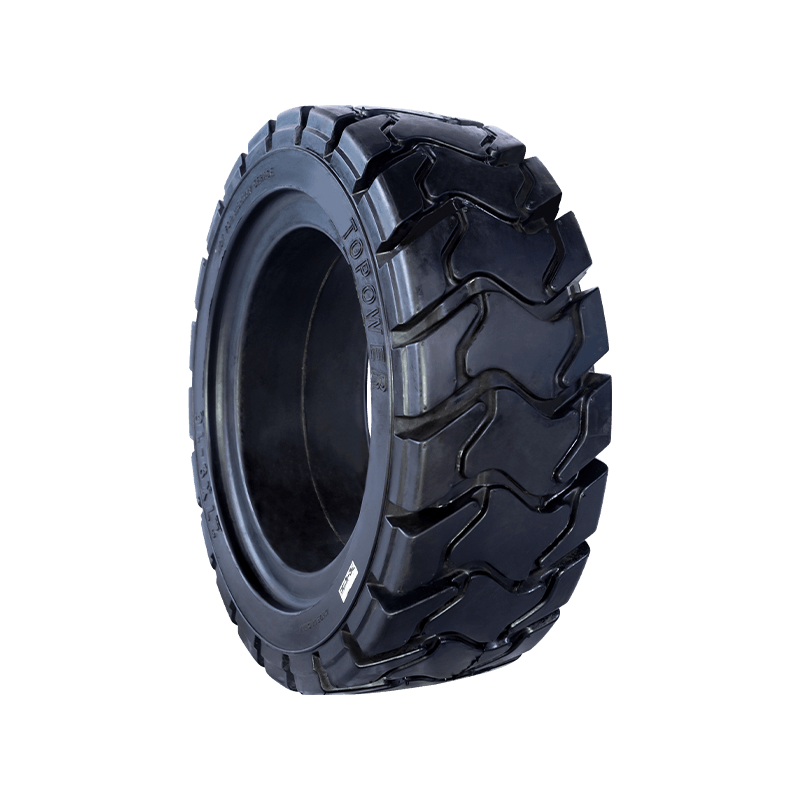
A forklift solid tyre, also called a non pneumatic forklift tyre, is constructed entirely from rubber compound without any internal air cavity, air tube, or air pressure dependency of any kind. The entire cross section from the outer tread surface to the inner mounting interface is solid rubber, engineered to provide the load bearing capacity, shock absorption, and traction required for forklift operation through the material properties of the compound itself rather than through air pressure.
This fundamental difference in construction produces a set of performance characteristics that differentiate solid tyres from both pneumatic tyres and foam filled tyres at every level of the operational comparison. The most operationally significant difference is the complete elimination of puncture risk and pressure maintenance requirements, which in production environments translates directly to eliminated downtime from flat tyres, eliminated compressor and inflation equipment costs, and eliminated operator time spent checking and correcting tyre pressures.
Solid Tyre Construction: Press On and Band On Types
Solid forklift tyres are produced in two distinct mounting configurations that are not interchangeable and must be matched to the specific wheel design used on the forklift model in question. Understanding the difference between these configurations is essential before any tyre selection or purchase decision.
The press on solid tyre is the most common type used on counterbalance forklifts and reach trucks. It consists of a solid rubber tyre body with a steel band bonded to the inner circumference. This steel band is machined to a slightly smaller diameter than the wheel rim onto which it is installed, and the tyre is pressed onto the rim under hydraulic force to achieve an interference fit that locks the tyre in place without any fasteners or retaining rings. The dimensional interference between the tyre band and the rim is the sole mechanism holding the tyre on the wheel during operation, including during braking, cornering, and load carrying maneuvers that generate significant lateral and rotational forces at the tyre to rim interface.
The band on or ring on solid tyre uses a different mounting approach in which the tyre is retained on the wheel by a separate outer retaining ring that is bolted through the wheel assembly. This configuration is used on forklifts with split rim wheels and provides a retaining mechanism that is mechanically locked rather than interference fit dependent. Band on tyres are more commonly found on older forklift models and on some specialized materials handling equipment.
Rubber Compound Grades: Standard, Premium, and Polyurethane
Within the press on solid tyre category, different rubber compound formulations produce different performance characteristics that are relevant to the selection decision. The three primary compound categories available in the market are standard black rubber, premium compound rubber, and polyurethane.
Standard black rubber solid tyres use a general purpose synthetic rubber compound that provides adequate performance across a broad range of indoor applications. These tyres offer reasonable load capacity, acceptable heat dissipation under moderate duty cycles, and satisfactory traction on smooth concrete and similar surfaces. They are the lowest cost solid tyre option and represent the appropriate specification for light duty applications with moderate daily operating hours.
Premium compound solid tyres are engineered with modified rubber formulations that improve one or more performance characteristics beyond what standard compound can achieve. Common premium compound properties include improved heat resistance for high speed or high cycle rate applications, enhanced cut and chunk resistance for outdoor and rough surface applications, lower rolling resistance for energy efficiency, and improved floor marking characteristics for indoor use where minimizing black rubber marks on finished floors is operationally important.
Polyurethane solid forklift tyres offer a fundamentally different performance profile from rubber alternatives. Polyurethane tyres deliver significantly lower rolling resistance than rubber equivalents, typically reducing energy consumption by 15 to 25 percent in electric forklift applications where battery runtime is a primary operational concern. Polyurethane also leaves no black marks on floor surfaces, making it the mandatory choice for facilities with food grade or pharmaceutical grade flooring requirements where rubber marking is unacceptable. The trade off is significantly reduced shock absorption compared to rubber, which makes polyurethane unsuitable for rough surface or outdoor applications where floor irregularities would transfer excessive vibration to the forklift structure and the operator.
How to Choose the Right Forklift Solid Tyre
Choosing the right solid forklift tyre requires evaluating six interdependent factors simultaneously: the correct size and specification for the specific forklift model, the operating surface conditions, the load rating required, the duty cycle intensity, the environmental conditions including temperature and chemical exposure, and the floor marking requirements of the facility. Getting any one of these factors wrong produces a tyre that either underperforms relative to its potential or fails prematurely relative to its expected service life.
Matching Tyre Size to Forklift Model and Load Rating
Every forklift manufacturer specifies the tyre size and type approved for each model in the machine's operator manual and the forklift data plate. These specifications are determined during the forklift's original design to ensure that the tyre's load carrying capacity, mounting dimensions, and overall rolling diameter are compatible with the machine's structural design, stability calculations, and performance characteristics. Installing a tyre with a different load rating, different tread diameter, or different section width than the manufacturer's specification without corresponding recalculation of the forklift's rated capacity is both unsafe and typically a violation of the forklift's type approval certification.
The tyre size designation used on solid press on forklift tyres follows a standardized format that encodes three critical dimensions: the outer tyre diameter, the tyre section width, and the rim diameter to which the tyre is fitted. A common example such as 18x7 8 indicates an 18 inch outer diameter, a 7 inch section width, and an 8 inch rim diameter. A tyre designated 21x8 9 indicates a 21 inch outer diameter, 8 inch section width, and 9 inch rim. These three dimensions must all match the forklift manufacturer's specification simultaneously; a tyre that matches on two dimensions but not the third cannot be fitted to the intended wheel.
The load index of the solid tyre must equal or exceed the maximum static load that the tyre will carry in service. For forklift drive axle tyres, this is calculated from the forklift's rated capacity, the forklift's own weight, and the load distribution between axles at maximum rated capacity with the load positioned at the standard load center. For a 3 tonne capacity counterbalance forklift, the drive axle may carry a combined load of 7 to 9 tonnes during a full capacity lift, which must be supported by the drive tyres with an appropriate safety margin above the tyre's rated static load capacity.
Tread Pattern Selection for Surface Conditions
Solid forklift tyres are produced with several tread pattern designs that suit different surface conditions and application requirements. The primary tread pattern categories are smooth tread, ribbed tread, lug tread, and combination tread.
- Smooth tread: Provides maximum contact area with the floor surface, producing the lowest floor pressure and best traction on smooth, clean concrete, epoxy, and similar indoor floor surfaces. The absence of tread voids means the entire tyre face is in contact with the floor, spreading load evenly and minimizing the risk of surface damage. Smooth tread solid tyres are the standard choice for indoor warehouses and manufacturing facilities with sealed concrete or coated floors.
- Ribbed tread: Features circumferential ribs separated by grooves that run around the tyre circumference. The ribs maintain a high proportion of the full tread contact area while the grooves provide channels for water, fine debris, and detritus to escape the contact zone, preventing the aquaplaning and reduced traction that can occur on wet smooth surfaces. Ribbed tread is a common choice for semi outdoor or indoor areas where the floor may be wet or lightly contaminated.
- Lug tread: Features raised blocks or lugs arranged in a pattern across the tyre face, providing aggressive traction on loose, unpaved, or rough outdoor surfaces where the lugs can dig into the surface material for grip. Lug tread is appropriate for outdoor yards, construction sites, agricultural facilities, and any application where the operating surface is unpaved or heavily contaminated. The trade off is higher floor pressure at each lug contact point, which makes lug tread unsuitable for finished indoor floors that must be protected from indentation.
- Combination tread: Uses a pattern that combines features of ribbed and lug designs, providing reasonable performance on both smooth and moderately rough surfaces. This pattern is appropriate for mixed use forklifts that operate both indoors on smooth surfaces and outdoors on paved or lightly unpaved areas, where a single tyre must serve adequately in both contexts without requiring tyre changes between locations.
Special Condition Tyres: Anti Static, Heat Resistant, and Chemical Resistant
Certain operating environments impose requirements beyond standard rubber compound performance that necessitate specially formulated solid tyre compounds. Anti static solid forklift tyres are compounded to maintain a controlled level of electrical conductivity, dissipating static charge build up that could create ignition risk in environments handling flammable materials, fine powder dusts, or electronic components sensitive to electrostatic discharge. Standard rubber is an electrical insulator; anti static compound provides a measured path for charge dissipation to ground through the tyre and floor surface without being fully conductive in a way that would create electrical hazard.
Heat resistant solid tyres are compounded to maintain their physical properties at elevated ambient temperatures that would accelerate the degradation of standard rubber. Cold storage facilities, on the other hand, require cold resistant compounds that remain flexible and grippy at temperatures well below zero degrees Celsius, where standard rubber compounds become stiff and lose traction efficiency. Chemical resistant compounds are used in environments where the floor surface may be contaminated with solvents, oils, acids, or other chemicals that attack standard rubber compounds.
Forklift Solid Tyre Sizes for Different Models
Forklift solid tyre sizes vary considerably across the range of forklift types, capacities, and manufacturers in the market. Understanding the size conventions and the typical size ranges associated with different forklift categories allows procurement teams, maintenance managers, and fleet operators to identify the correct tyre specification efficiently and verify that alternative suppliers are offering genuinely equivalent products rather than similar appearing tyres with different dimensional specifications.
| Forklift Type | Typical Capacity Range | Common Drive Tyre Sizes | Common Steer Tyre Sizes | Typical Compound |
|---|---|---|---|---|
| Electric counterbalance (small) | 1.0 to 2.0 tonne | 15x5 9, 16x6 10.5 | 12x4.5 8, 13x5 9 | Polyurethane or premium rubber |
| Electric counterbalance (medium) | 2.0 to 3.5 tonne | 18x7 8, 21x8 9 | 15x5 9, 16x6 10.5 | Premium rubber or polyurethane |
| LPG or diesel counterbalance (medium) | 2.0 to 3.5 tonne | 21x8 9, 22x9 10 | 18x7 8, 200x50 127 | Standard or premium rubber |
| LPG or diesel counterbalance (large) | 4.0 to 7.0 tonne | 28x9 15, 250x70 15 | 21x7 15, 23x9 10 | Heavy duty premium rubber |
| Reach truck | 1.0 to 2.5 tonne | 150x50 100, 180x60 110 | 230x75 150, 250x80 150 | Polyurethane or premium rubber |
| Order picker and pallet truck | 0.5 to 1.5 tonne | 230x80 150, 250x75 150 | 82x90 60, 85x90 60 | Polyurethane |
Beyond the standard sizing conventions, forklift tyres are also produced in metric designations where the section width and rim diameter are expressed in millimeters rather than inches. A tyre designated 250x70x15 indicates a 250mm section width, 70mm section height, and 15 inch rim diameter. Metric and inch based size designations are not interchangeable and require careful verification when sourcing tyres from suppliers who may use different measurement conventions in their catalogs or databases.
Always verify the tyre specification against the forklift's original manufacturer documentation rather than simply measuring the worn tyre being replaced. Worn tyres have reduced outer diameters and may have deformed section widths that no longer accurately represent the original installed dimensions. Measuring a worn tyre as the basis for replacement specification risks ordering a tyre smaller than the machine's designed specification, potentially affecting the forklift's rated capacity, stability, and performance.
Solid Forklift Tyres for Indoor vs Outdoor Use
The operating environment is one of the most decisive factors in solid forklift tyre selection, and the distinction between indoor and outdoor use encompasses not just tread pattern but compound hardness, heat resistance, load capacity requirements, and the specific type of surface damage and contamination the tyre will encounter during its service life. A tyre optimized for indoor smooth floor operation will typically wear much more rapidly and perform significantly worse on outdoor surfaces, and vice versa.
Indoor Solid Tyres: Performance on Smooth Surfaces
Indoor forklift operations on smooth concrete, epoxy coated, or tiled floors are characterized by predictable surface conditions, moderate temperatures, clean operating environments, and typically higher cycle rates than outdoor operations. These conditions favor tyres with smooth or lightly ribbed tread patterns that maximize contact area, softer compound grades that provide better shock absorption on hard floors and reduce vibration transmitted to the operator, and compounds formulated to minimize floor marking.
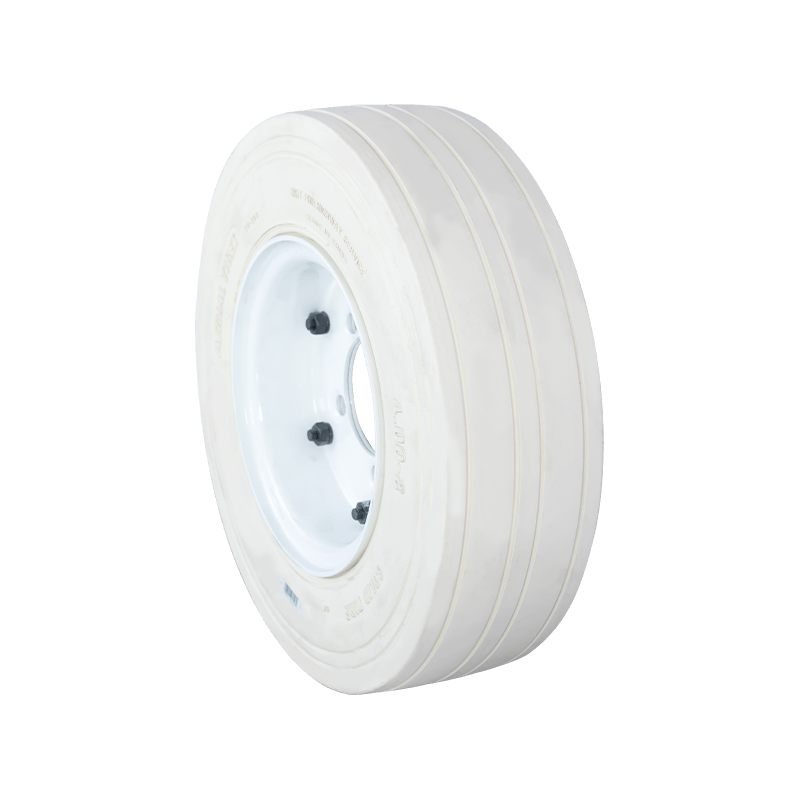
Floor marking is a specific concern in indoor warehouse and manufacturing environments. Standard black rubber solid tyres leave black scuff marks on floor surfaces during cornering and braking maneuvers, particularly under higher loads and faster travel speeds. These marks are not structurally damaging to properly sealed floors but are a housekeeping and aesthetic issue in many facilities, particularly in food distribution, pharmaceutical, and retail environments where floor appearance is a quality or regulatory consideration. Non marking solid tyres in white, grey, or other light colored compound formulations eliminate this issue entirely, making them the standard specification for food production, cleanroom, and retail distribution applications where floor marking is unacceptable.
In cold storage facilities operating at temperatures of minus 18 degrees Celsius and below, standard rubber compounds become significantly stiffer and lose both their cushioning properties and their grip on smooth cold floors. Cold grade solid tyre compounds maintain flexibility and traction at these temperatures, providing performance equivalent to ambient temperature operation. The shift from standard compound to cold grade compound is not optional in cold storage applications; a standard compound tyre operating at cold storage temperatures can become sufficiently rigid to transmit excessive vibration to the machine structure, reduce grip to unsafe levels on icy or frosted floors, and wear in an accelerated and uneven pattern.
Outdoor Solid Tyres: Performance on Rough and Contaminated Surfaces
Outdoor forklift operations present a fundamentally different set of tyre performance requirements from indoor use. Outdoor surfaces including concrete yards, paved loading areas, unpaved storage areas, and construction or agricultural sites expose the tyre to physical hazards including sharp debris, stones, metal fragments, irregular surface profiles, and standing water. The primary tyre performance requirements in these conditions shift from floor protection and marking toward cut and chunk resistance, thermal stability, and load capacity under less predictable surface contact conditions.
Cut and chunk resistance is the most important compound property for outdoor solid tyre performance. Sharp debris on outdoor surfaces, including metal swarf in industrial yards, stone aggregate on paved surfaces, and angular rocks on unpaved ground, can cut into the tyre surface and cause sections of compound to tear away from the tyre body. This chunking reduces the tyre's effective load bearing cross section and accelerates subsequent deterioration at the damaged area. Premium outdoor grade solid tyre compounds achieve cut resistance values 40 to 60 percent higher than standard indoor compounds by incorporating modified rubber formulations that maintain elasticity under impact while resisting tear propagation from surface cuts.
Outdoor solid tyres also require greater heat stability than indoor equivalents. Outdoor forklift cycles typically involve higher travel speeds over longer distances compared to the short cycle, low speed operation of indoor warehouse forklifts. Higher speed and longer travel distances generate more heat within the solid rubber mass, and this heat must dissipate efficiently to prevent the compound softening and accelerated wear that occurs when solid tyre operating temperature exceeds the compound's thermal design range. Outdoor rated compounds include heat stable additives that maintain their physical properties at the elevated operating temperatures generated by extended high speed outdoor travel.
Mixed Use: Forklifts Operating Both Indoors and Outdoors
A common operational scenario is the forklift that regularly transitions between indoor smooth floor operation and outdoor yard or loading dock operation. This mixed use profile creates a genuine specification compromise, since the optimal indoor tyre and the optimal outdoor tyre have different compound formulations and tread patterns that cannot be simultaneously optimized for both environments.
The practical guidance for mixed use applications is to select the tyre specification based on where the majority of operating hours and the most demanding conditions occur. If 80 percent of operating time is indoors on smooth floors with 20 percent on paved outdoor surfaces, an indoor optimized premium compound tyre with combination tread will serve adequately in both environments. If outdoor operation involves unpaved surfaces, heavy debris, or extended travel distances even for a minority of operating time, the outdoor requirement should drive the specification decision, with the acceptance that the tyre may leave slightly more marking on indoor surfaces than a dedicated indoor tyre would.
How Long Do Solid Forklift Tyres Last
The service life of solid forklift tyres is one of the most practically important specifications for fleet operators and maintenance managers, yet it is also one of the most variable, because tyre longevity depends on a combination of factors including the tyre compound and quality, the forklift model and weight, the operating surface conditions, the operating duty cycle intensity, the operator behavior, and the quality of ongoing fleet maintenance. Providing a single service life figure without specifying these variables is not meaningful. Understanding how each factor influences service life allows realistic predictions for specific operations.
Typical Service Life Ranges by Application
Under typical single shift indoor warehouse operation on smooth concrete, a quality premium compound solid drive tyre on a 2 to 3 tonne counterbalance forklift will typically achieve 3,000 to 5,000 operating hours before reaching the wear indicator limit. This translates to approximately 18 months to 3 years of service for a single shift operation running the forklift for 1,600 to 2,000 hours per year.
Multi shift operations that run the same forklift for 4,000 or more hours per year will reach the same tyre wear indicator in 9 to 15 months rather than 18 to 36 months. Outdoor operations on rough surfaces can reduce service life to 1,500 to 2,500 hours for the same tyre specification due to accelerated tread wear and surface damage from debris contact. Very light duty applications such as low frequency indoor pallet movement may achieve 6,000 hours or more from the same premium compound tyre specification.
Polyurethane solid tyres, when used in their optimal indoor smooth floor application on electric counterbalance and reach trucks, typically achieve 5,000 to 8,000 operating hours before reaching wear limit, significantly outperforming rubber compounds in terms of raw wear resistance on smooth surfaces. This extended service life is a key economic justification for the higher purchase price of polyurethane versus rubber solid tyres in appropriate applications.
The Wear Indicator: When to Replace Solid Forklift Tyres
Solid forklift tyres incorporate a wear indicator, also called a wear line or safety line, which is a circumferential groove or color coded layer molded into the tyre at a specified depth below the new tyre outer surface. When the tyre wears down to the level of the wear indicator, the tyre has consumed its designed service allowance and must be replaced. Continuing to operate a forklift on tyres that have reached or passed the wear indicator is unsafe and in most jurisdictions constitutes a violation of workplace health and safety requirements for forklift maintenance standards.
The wear indicator on most solid forklift tyres is positioned at a point where 30 to 40 percent of the original rubber mass above the steel band remains. Beyond this point, the remaining rubber has insufficient depth to absorb normal operational shocks adequately, the reduced rubber mass generates more heat per unit of rubber volume under load, and the structural integrity of the tyre body to rim interface becomes increasingly marginal as the rubber section thins. Operating below the wear indicator line accelerates deterioration significantly and creates the risk of sudden tyre failure that can cause the forklift to behave unpredictably.
A practical tyre inspection program in a well managed forklift fleet includes weekly visual checking of tyre depth relative to the wear indicator, monthly dimensional measurement of tyre diameter at multiple points around the circumference to detect uneven wear, and immediate investigation of any tyre showing chunking, cracking, separation between the tyre body and the steel band, or flat spots from skid braking incidents. These conditions warrant tyre replacement before the wear indicator is reached.
Factors That Shorten or Extend Solid Tyre Service Life
- Surface quality: Clean, smooth concrete is the least abrasive surface for solid tyres. Contaminated, rough, or debris covered surfaces dramatically accelerate wear. Even fine abrasive particles like sand and concrete dust on an otherwise smooth floor surface increase wear rates measurably compared to a clean equivalent surface.
- Operating speed and turning frequency: High travel speeds and frequent sharp turns generate more heat and lateral scrubbing wear than slow, straight travel. Operations with high turning frequency in confined spaces, such as narrow aisle order picking, wear drive and steer tyres significantly faster than open floor travel operations at similar loads and duty cycles.
- Load weight relative to tyre rating: Operating a forklift consistently at the upper end of its rated capacity places higher stress on the tyres than lighter load operation. While tyres are rated for the forklift's maximum capacity, frequent maximum load operation accelerates the internal heat generation within the solid tyre mass and produces higher contact pressures that increase surface wear rate.
- Operator driving habits: Aggressive acceleration and braking, particularly sudden stops from travel speed, create flat spots and accelerated wear at the braking contact point. These flat spots produce vibration during subsequent operation and represent premature wear that reduces effective tyre life by 15 to 30 percent compared to smooth, controlled operation in equivalent conditions.
- Ambient temperature: High ambient temperatures increase the baseline operating temperature of solid tyres, compounding the heat generated by operation itself. In facilities where ambient temperature regularly exceeds 35 to 40 degrees Celsius, tyre service life may be reduced by 20 to 35 percent compared to the same operation in a temperature controlled environment.
How to Install Solid Tyres on Forklifts
Installing solid press on forklift tyres is not a task that can be safely performed with general workshop tooling. The interference fit between the tyre steel band and the wheel rim requires hydraulic pressing force of several tonnes to overcome, and attempting to fit a solid tyre by driving it on with impact tools, hammers, or improvised levers creates the risk of damaging the tyre, damaging the wheel rim, and injuring personnel. Correct solid tyre installation requires a hydraulic tyre press specifically designed for forklift solid tyre fitting, and should be performed by trained personnel familiar with the equipment and the installation procedure.
Pre Installation Inspection and Preparation
Before beginning the tyre installation process, both the new tyre and the wheel rim must be inspected and prepared. The wheel rim inspection should check for:
- Corrosion or pitting on the rim seating surface that would prevent the tyre band from seating uniformly and could allow the tyre to rotate on the rim under operating loads
- Deformation or out of round condition from impact damage that would prevent the tyre from being pressed on concentrically, resulting in runout and vibration in service
- Burrs or raised edges on the rim that could damage the tyre band during pressing or prevent full seating depth
- Dimensional verification that the rim diameter is within specification, as a rim worn or corroded below its design diameter may not provide adequate interference fit retention for the new tyre
Clean the rim seating surface thoroughly with a wire brush and clean cloth to remove all rust, old rubber residue from the previous tyre, and any contamination that would affect the fit quality. A light coating of mounting lubricant on the rim seating surface immediately before pressing reduces the insertion force required and helps achieve a uniform seating depth. Use only lubricants specifically recommended for solid tyre installation; petroleum based lubricants can attack the rubber compound of the tyre band and should not be used.
The Hydraulic Pressing Procedure
- Position the wheel in the press: Place the cleaned wheel rim on the press bed with the correct face up according to the press manufacturer's instruction for the wheel size and type being fitted. Ensure the wheel is centered on the press bed and will receive the pressing force concentrically over its full circumference.
- Position the tyre over the rim: Place the new solid tyre over the wheel with the tyre orientation matching the directional requirement of the forklift (drive direction, rotation direction arrows where marked). The tyre should be started squarely onto the rim top edge before pressing begins. A tyre started at an angle will press on unevenly, creating a cocked installation that causes runout and premature failure.
- Apply pressing force gradually: Operate the hydraulic press to apply downward force to the tyre, pressing it progressively onto the rim. The required pressing force for a standard counterbalance forklift drive tyre is typically 15 to 40 tonnes depending on tyre size and interference specification. Monitor the pressing operation to confirm the tyre is moving squarely onto the rim without tilting, and stop immediately if the tyre begins to cant to one side.
- Verify full seating: The tyre is correctly installed when the tyre band's inner shoulder contacts the rim flange uniformly around the full circumference and the tyre face is perpendicular to the wheel centerline. A correctly pressed tyre will have a consistent gap between the tyre sidewall and the rim flange edge around the full circumference. Any point where this gap is noticeably larger or smaller than adjacent positions indicates non concentric installation that requires correction.
- Inspect after pressing: After removing the assembly from the press, inspect the tyre and rim for any visible damage caused during installation, check that no lubricant or debris is trapped between the tyre band and rim seating surface, and verify that the tyre sits squarely on the rim when the wheel is placed on a flat surface and rolled. A tyre that wobbles when rolled indicates that it is not correctly seated and requires re pressing.
Reinstallation on the Forklift
After the new tyre has been correctly pressed onto the rim, reinstall the wheel assembly on the forklift following the manufacturer's specified procedure and torque requirements for the wheel nuts or bolts. Incorrect wheel fastener torque is a leading cause of wheel loosening in service, and both under tightening and over tightening create the conditions for fastener failure. Use a calibrated torque wrench and tighten fasteners in the correct sequence specified in the forklift's service manual, re torquing after the first full shift of operation as fasteners may settle slightly as the new tyre bedded into its operating position.
After returning the forklift to service, conduct a brief operational check that includes confirming smooth, vibration free travel, correct steering response at low speed, and confirming that no unusual noises are present from the newly fitted wheel assembly during operation and braking. Any vibration, noise, or handling anomaly detected during this check should be investigated before returning the forklift to normal production service.
Impact of Solid Tyres on Forklift Performance
The tyre specification installed on a forklift has measurable effects on multiple dimensions of machine performance that extend well beyond simple traction and wear considerations. Tyre type, compound, and condition influence forklift stability, operator comfort and fatigue, energy efficiency, floor and structure maintenance requirements, and the machine's effective load capacity in specific operating scenarios. Understanding these performance impacts allows informed tyre specification decisions that optimize overall operational outcomes rather than minimizing only the initial tyre purchase cost.
Stability and Load Capacity Effects
The overall rolling diameter of the installed tyre directly affects the forklift's stability triangle geometry and, consequently, its rated capacity. A tyre with a larger outer diameter raises the center of gravity of the forklift and its load slightly, reducing the stability margin relative to the same forklift fitted with the correct tyre diameter. This effect is small but measurable: a tyre with an outer diameter 50mm greater than specification raises the forklift's center of gravity sufficiently to require a reduction in rated lifting capacity of approximately 3 to 5 percent to maintain the same stability margin.
Solid tyre compound hardness also influences lateral stability during cornering. Harder compounds deflect less under lateral load than softer compounds, providing a more predictable lateral behavior and slightly higher cornering stiffness. Softer compounds provide better cushioning but allow more lateral deformation under side forces, which can produce a slight rocking sensation during sharp turns at speed, particularly on forklifts with high mast assemblies that amplify lateral movement at the mast top.
Operator Comfort and Whole Body Vibration
Solid tyres transmit more vibration to the forklift structure and the operator than pneumatic tyres on equivalent surfaces, and this vibration transmission has real consequences for operator comfort, fatigue, and long term health. Whole body vibration exposure from forklift operation is a recognized occupational health issue, with regulatory exposure limits established in most industrial jurisdictions. The tyre compound selection significantly influences the vibration levels transmitted to the operator seat.
Softer solid tyre compounds absorb more of the shock energy from floor irregularities and reduce the peak vibration amplitudes transmitted to the machine structure. Comparative testing has shown that a soft compound premium solid tyre reduces operator seat vibration by 15 to 25 percent compared to a hard compound standard solid tyre of the same size on identical floor surfaces. Over a full shift of operation, this difference in vibration level is significant both in terms of operator fatigue and cumulative vibration exposure compliance.
Polyurethane solid tyres, despite their excellent wear and energy efficiency characteristics, typically transmit more vibration to the machine structure than equivalent rubber solid tyres due to the higher stiffness of polyurethane compound. This characteristic limits polyurethane to applications on very smooth floors where the vibration input from floor irregularities is minimal. On floors with expansion joints, surface damage, or even minor surface profile variation, the vibration transmitted through polyurethane tyres can exceed acceptable whole body vibration exposure limits for sustained operation.
Energy Efficiency and Battery Runtime in Electric Forklifts
For electric counterbalance forklifts and reach trucks, tyre rolling resistance is a direct component of the energy demand on the battery and a meaningful determinant of battery runtime per charge cycle. Every watt hour consumed by tyre rolling resistance is a watt hour unavailable for lifting, travel drive, and auxiliary functions. In a typical electric counterbalance forklift operating in a single shift, tyre rolling resistance may account for 15 to 25 percent of total energy consumption, making it a significant factor in the operational economics of the machine.
Polyurethane solid tyres, with rolling resistance coefficients 40 to 60 percent lower than rubber solid tyres of equivalent size, provide the most direct energy saving of any tyre compound choice. In practice, switching from standard rubber solid tyres to polyurethane on an appropriate application can extend battery runtime per shift by 10 to 20 percent, which in an operation running close to the limits of battery capacity represents the difference between completing the shift on a single charge or requiring an opportunity charge or battery change during the shift.
Premium rubber compound tyres with optimized rolling resistance formulations offer an intermediate position: better rolling resistance than standard rubber compound, reduced vibration compared to polyurethane, and applicability on surfaces where polyurethane would be too stiff. These tyres represent the appropriate balance between energy efficiency and operator comfort in mixed use applications where polyurethane is not suitable due to surface conditions.
Floor and Infrastructure Impact
The contact pressure between the forklift tyre and the floor surface is determined by the load on the tyre and the contact area the tyre presents to the floor. Solid tyres, with their larger contact area compared to pneumatic tyres of the same nominal size, distribute load over a larger area and produce lower peak contact pressures than pneumatic tyres at equivalent loads. This characteristic makes solid tyres favorable for floor loading in environments where the floor slab is designed to specific point load limits.
The contact pressure advantage of solid over pneumatic tyres is negated if the solid tyre is worn significantly below its new tyre dimensions. A significantly worn solid tyre has a reduced contact patch area, with load concentrated in a smaller zone that produces contact pressures approaching those of a pneumatic tyre at the same load. This is one of the operational arguments for timely tyre replacement: maintaining solid tyre dimensions above the wear indicator limit preserves the contact area and floor pressure characteristics for which the floor was originally designed.
Performance Impact Summary
| Performance Factor | Standard Rubber Solid | Premium Rubber Solid | Polyurethane Solid |
|---|---|---|---|
| Rolling resistance (energy efficiency) | Moderate | Moderate to low | Very low (40 to 60% less than rubber) |
| Vibration transmitted to operator | Moderate | Low to moderate | High (harder compound) |
| Floor marking | Black marks on smooth floors | Reduced or non marking versions | None |
| Outdoor rough surface performance | Adequate | Good | Not suitable |
| Typical service life (indoor smooth floor) | 2,000 to 3,500 hours | 3,000 to 5,000 hours | 5,000 to 8,000 hours |
| Battery runtime improvement (electric FL) | Baseline | 5 to 10% better than baseline | 15 to 20% better than baseline |
| Relative purchase cost | Low | Medium | High |
Solid Tyre Economics: Total Cost of Ownership vs Purchase Price
Fleet managers who evaluate forklift solid tyre procurement on purchase price alone consistently make suboptimal decisions that increase total maintenance costs and reduce operational efficiency relative to what a full lifecycle cost analysis would recommend. The economics of forklift solid tyre selection become clear when all relevant cost elements are included in the comparison: the tyre purchase price, the installation labor and equipment cost, the service life in operating hours, the impact on forklift energy consumption, the frequency of maintenance interventions associated with the tyre choice, and the cost of any tyre related downtime events.
Consider a practical example comparing standard rubber and premium rubber solid drive tyres for a 3 tonne electric counterbalance forklift operating 3,500 hours per year in a distribution center on smooth concrete. If the standard rubber tyre costs 60 percent of the premium tyre price but delivers only 55 percent of the service life, the cost per operating hour of the premium tyre is lower despite its higher purchase price. Adding the energy saving from the premium tyre's lower rolling resistance and the reduction in installation labor from fewer tyre changes per year further increases the economic advantage of the premium specification.
For high duty cycle electric forklift applications, the premium or polyurethane solid tyre specification almost always produces a lower total cost of ownership over a 3 to 5 year fleet management horizon than the standard compound specification, despite the higher initial purchase price. The break even point at which the premium tyre's cost advantage over standard compound is fully realized varies by application but typically occurs within 12 to 18 months of operation for 2 shift applications, and within 6 to 9 months for 3 shift operations.
Procurement decisions that focus on initial price without considering the service life, energy efficiency, and maintenance frequency implications of different tyre specifications are a common source of unnecessary cost in forklift fleet management. Building a specification and procurement process based on verified total cost of ownership for the specific operating conditions of each fleet consistently reduces the actual cost of tyre related expenditure over the fleet management horizon.